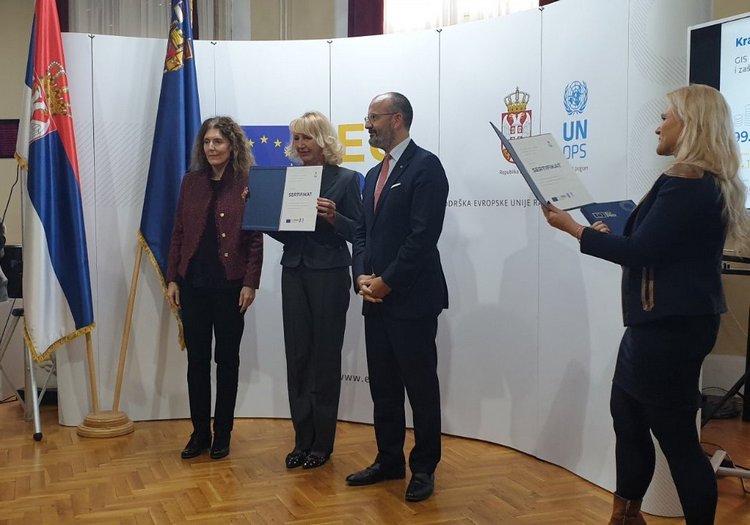
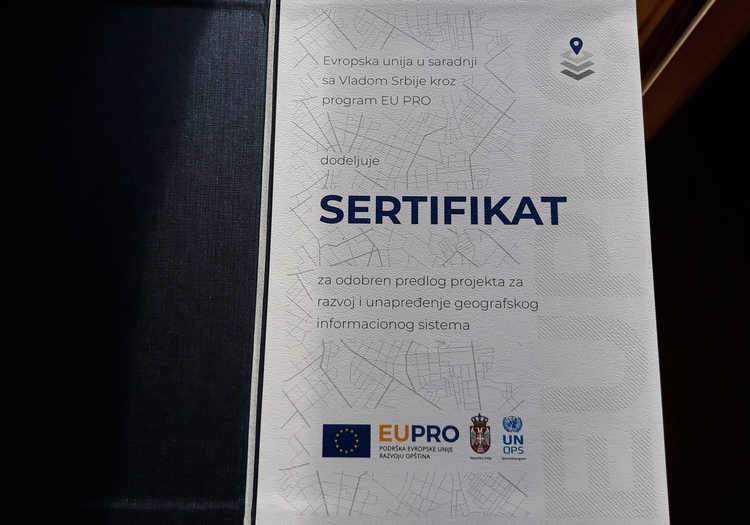
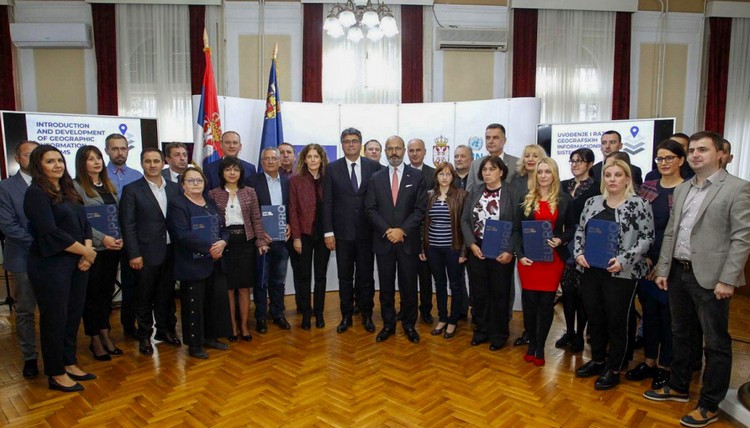
The Head of the EU Delegation to Serbia, the Ambassador Sem Fabrizi presented in Nis certificates for the implementation of 19 projects that would improve GIS in 34 local self – governments. In cooperation with the Goverment of Serbia through the EU PRO programme, the EU with 2 million Euros will support the acquisition of Software and Hardware and other computer equipment which will help to local – self governments to create the preconditions for sustainable development. With these tools, local governments will be able to collect, process, and manage spatial data in one place, better plan local development and resource management, while local government employees will receive GIS training. City of Kragujevac is one of the certificate awarded cities and as the example of the best practice the Project “City of Kragujevac GIS Development and Improvement” is presented. On behalf of the City the Certificate for the GIS Development and Improvement project is handed over to the head of Sumadija Administrative District Biljana Ilic- Stosic.
The key idea of these projects is to improve the quality of life of the citizens of Serbia, declared the Head of the EU Delegation to Serbia, the Ambassador Sem Fabrizi. The EU for many years now successfully implements different projects in Serbia that in the beginning met the most urgent needs of the citizens and then the new one were developed. Today we talk about the future through digitalisation, that is one of the biggest challenges in the sense of scientific achievements, transparency, innovations, artificial intelligence, open data. We have a big challenge ahead and that is one of the reason why GIS may seem abstract now, but that is an instrument for large quantity data management. Second challenge is the utilization of data for the projects meant for citizens. That could be planning, cadastral, traffic, tourism, said Mr. Fabrizio.
At the public call for the project proposals submission for the GIS introduction the City of Kragujevac participated in partnership with the Municipalities Knic and Rekovac. GIS is significant not only for the citizens but for the economy too because it improves the public infastructure, spatial and urban planning, tourist potentials promotion, preservance and promotion of the natural, cultural and urban inheritance. Concretely, local self-governments would be able to respond promptly both to the citizens and investors requirements. The activities will be implemented in 12 administration regions and direct benefit for 67 public companies, 14 public institutions, 13 tourism organisation and over 7.300 agricultural households and number of the private companies.